

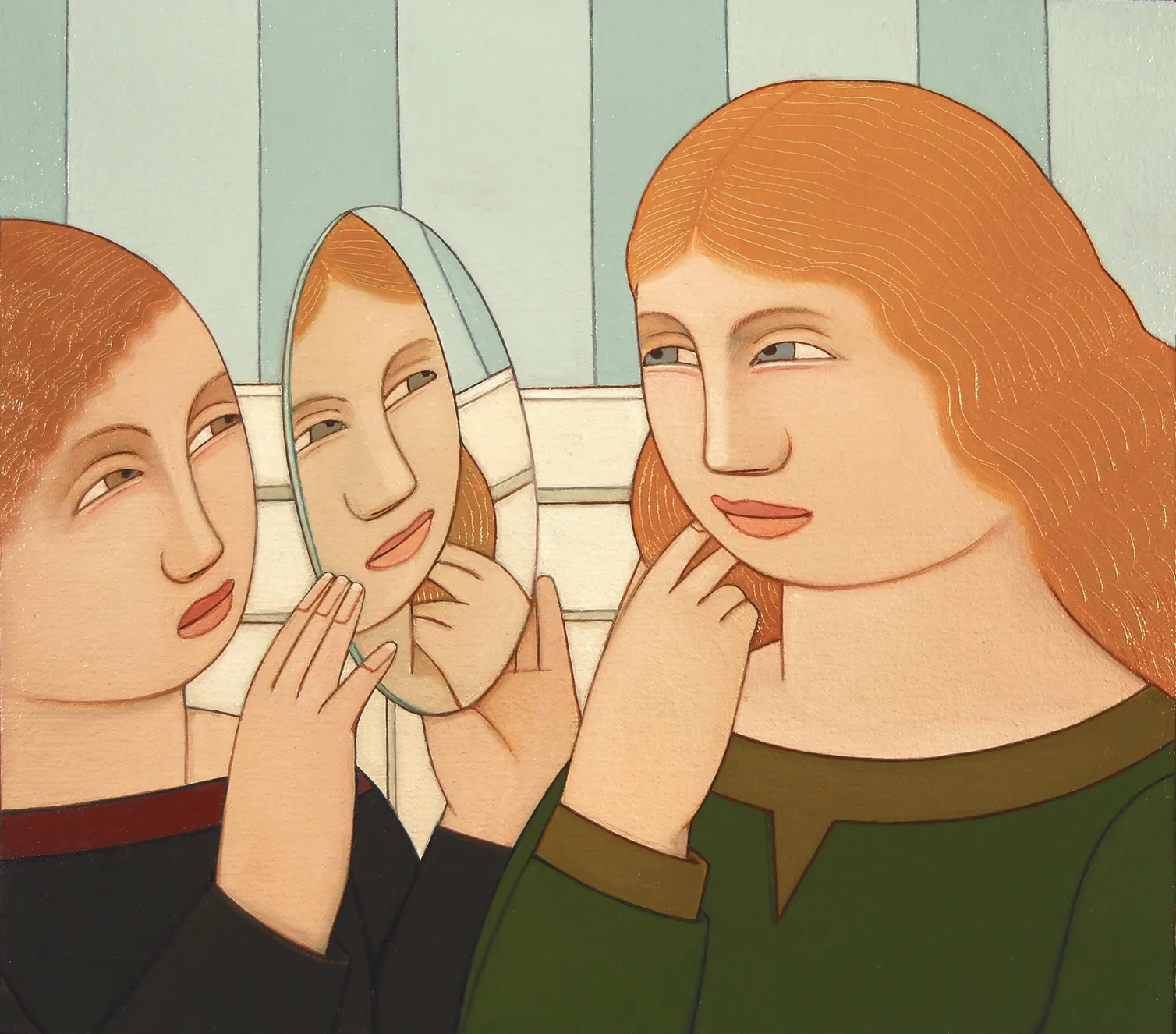
- Two Women with a Mirror
- 2013
- Oil on linen canvas
- 8 x 9 inches
- 20.3 x 22.9 cm
- Private Collection
- View Artwork Page
This website serves as a catalogue raisonné of the work of Andrew Stevovich. It has been developed as a comprehensive, long-term record of his artistic output and career, bringing together artworks, exhibitions, publications, writing, and related materials within a single, interconnected archive.
The catalogue is intended to document the work as fully and accurately as possible, while remaining open to continued discovery, clarification, and expansion over time. It is not a curated selection or retrospective summary, but a sustained effort to assemble the complete record of a lifetime of work.
Catalogue as Data
This catalogue raisonné is fundamentally built on structured data, which serves as the core archive of Andrew Stevovich’s complete body of work. The site itself functions as an interactive interface, presenting this data in an accessible format, but the true catalogue artifact resides in the structured data file (currently in JSON format). This data forms the foundation of the project and is the primary, long-term record of Andrew Stevovich’s career.
Unlike traditional print catalogues that are fixed and static, the structured data archive is designed to remain accessible and parseable for future generations. Even if the website becomes obsolete or inaccessible, the data artifact will persist in a format that can be transcribed into modern systems and displays, ensuring the catalogue’s long-term survival and relevance. The catalogue’s integrity lies in this structured data, which preserves the artist’s work and contextual information across various media and technologies.
This approach guarantees that the catalogue remains a living archive — continuously expanding, correcting, and refining — while providing an everlasting record of Andrew Stevovich’s art for researchers, curators, and future generations. The underlying data will always be available, regardless of technological changes, and can be easily adapted for future systems and formats.
Scope of the Catalogue
The catalogue includes Andrew Stevovich’s complete body of oil paintings to date, alongside related works in drawing, pastel, watercolor, and print. In addition to finished works, the archive incorporates preparatory materials such as studies, sketches, and related drawings where documentation exists.
Beyond artworks themselves, the catalogue records the public life of the work, including exhibitions, publications, critical writing, and public collections. These materials are treated as integral components of the artist’s career rather than as secondary references.
The catalogue is ongoing. As additional works, documentation, or contextual materials are located, they are incorporated into the archive in a manner consistent with its existing structure.
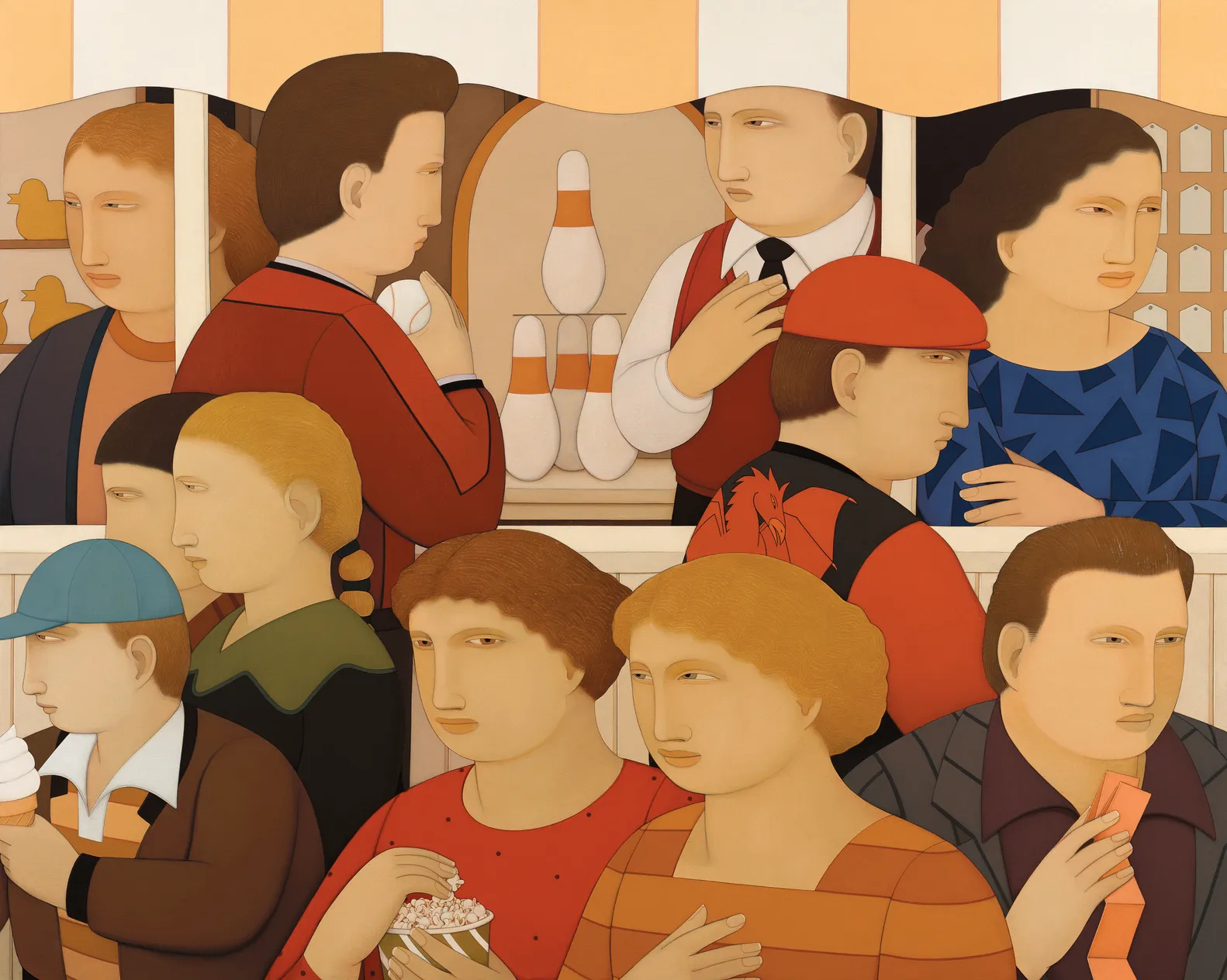
- Carnival
- 1991–1992
- Oil on linen canvas
- 48 x 60 inches
- 121.9 x 152.4 cm
- Private Collection
- View Artwork Page
Structure and Relationships
The catalogue is organized around relationships rather than isolated lists. Artworks, exhibitions, publications, reviews, and related materials are cross-referenced throughout the site, allowing each record to be viewed within its broader context. For example, individual artwork entries may reference:
- Preparatory drawings or related studies.
- Exhibitions in which the work appeared.
- Publications in which it was reproduced
- Critical writing in which it is discussed
Conversely, exhibition and publication records link back to the artworks they include, allowing navigation to move in multiple directions across the archive.
This relational structure is central to the catalogue’s design. It reflects the understanding that an artist’s work is not best understood through chronology or medium alone, but through the evolving network of connections that emerge over time.
Data-Driven Catalogue
This catalogue is fundamentally built around structured data, which holds all relationships and data points associated with Andrew Stevovich’s artworks. The website itself is a digital output of this data, presenting a interface to view complex catalogue data and relationships in novel and interesting ways. While the site serves as an interactive tool for exploring the collection, the integrity of the catalogue lies in its pure data form. The data structure ensures that all connections—between artworks, exhibitions, reviews, and public collections—are faithfully maintained, offering a comprehensive, accurate record of the artist's career.
Titles, Dates, and Archival Decisions
Where possible, artworks are presented with consistent titles, dates, and material descriptions based on available documentation. In cases where titles, dates, or details have varied historically, archival decisions have been made with care and transparency.
When discrepancies exist, they are resolved through reference to studio records, exhibition history, publications, and family-held documentation. The catalogue does not attempt to erase ambiguity where it legitimately exists, but instead seeks to establish a stable and usable record.
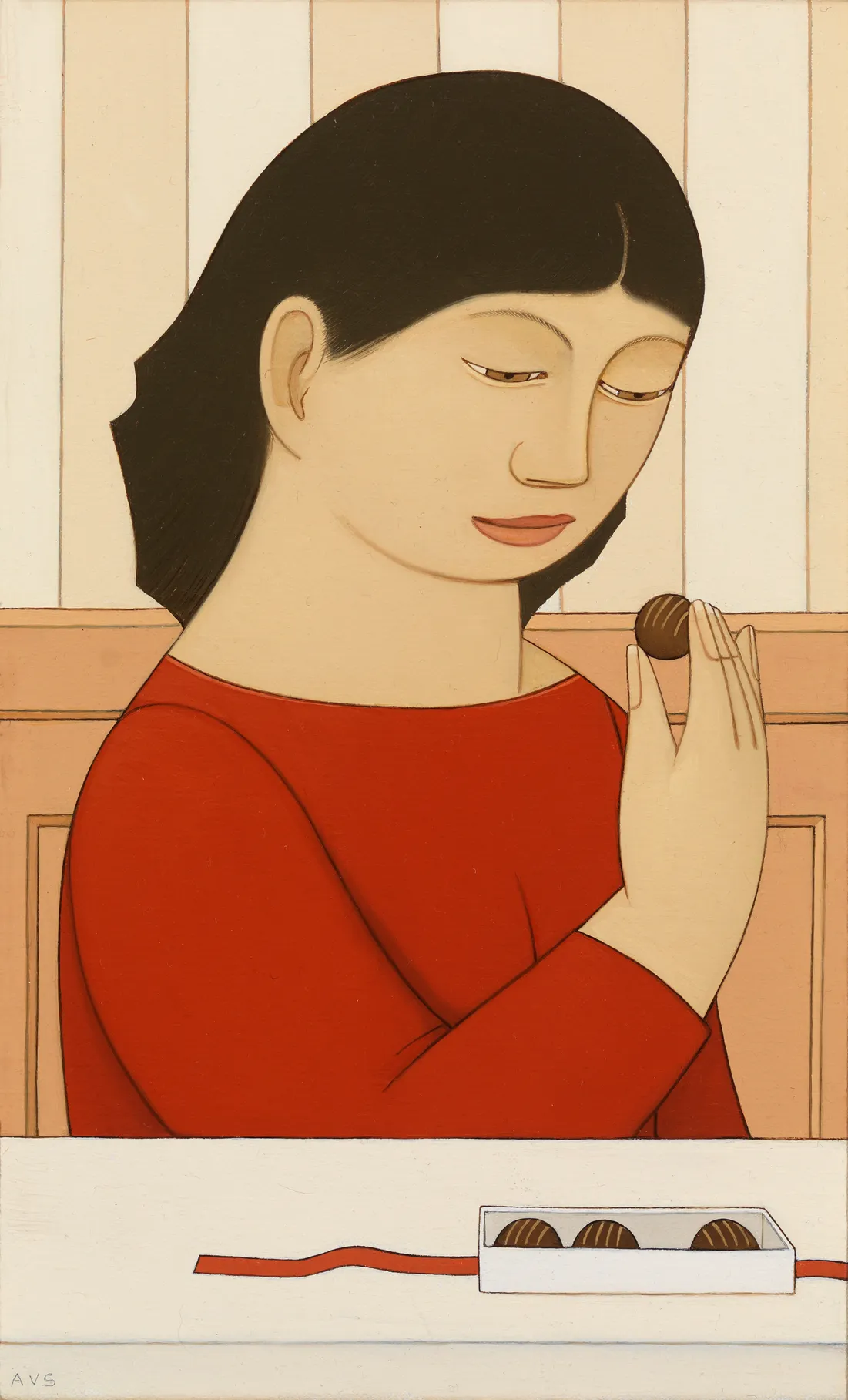
- Choolate Truffles
- 2013
- Oil on linen canvas
- 12 x 7.25 inches
- 30.5 x 18.4 cm
- Private Collection
- View Artwork Page
Mediums and Working Process
Andrew Stevovich’s practice is centered primarily on oil painting, with many works developing through extended preparatory drawing and study. The catalogue reflects this process by linking related works across mediums where appropriate.
While oil paintings form the core of the archive, works in other media are included as part of the broader artistic record. A small number of informal or atypical works are also documented, acknowledging the full scope of the artist’s activity without conflating these works with the primary body of practice.
Themes and Groupings
In addition to organization by medium and chronology, the catalogue presents groupings by theme. These thematic groupings are intended to highlight recurring ideas, subjects, and visual concerns that emerge across the work over time.
Themes are not intended to prescribe interpretation, but to offer an additional lens through which relationships between works can be explored. As the catalogue continues to evolve, thematic groupings may expand or shift in response to new material and ongoing review.
Writing and Critical Material
The catalogue includes critical writing, reviews, and essays related to Andrew Stevovich’s work, alongside texts authored by the artist himself. These materials are presented as part of the historical record and are linked to relevant artworks, exhibitions, and publications where applicable.
Catalogue Attribution
Cataloguer
This catalogue raisonné has been researched, designed, and developed by Alex Stevovich as an independent archival project. The work draws upon studio materials, published sources, exhibition records, and independently assembled documentation. The project encompasses archival research, editorial decision-making, data modeling, and the design and implementation of the catalogue’s technical and visual structure.
The catalogue reflects a long-term commitment to stewardship, accuracy, and clarity, with the goal of preserving the integrity of the record while allowing the archive to remain adaptable and open to future growth.
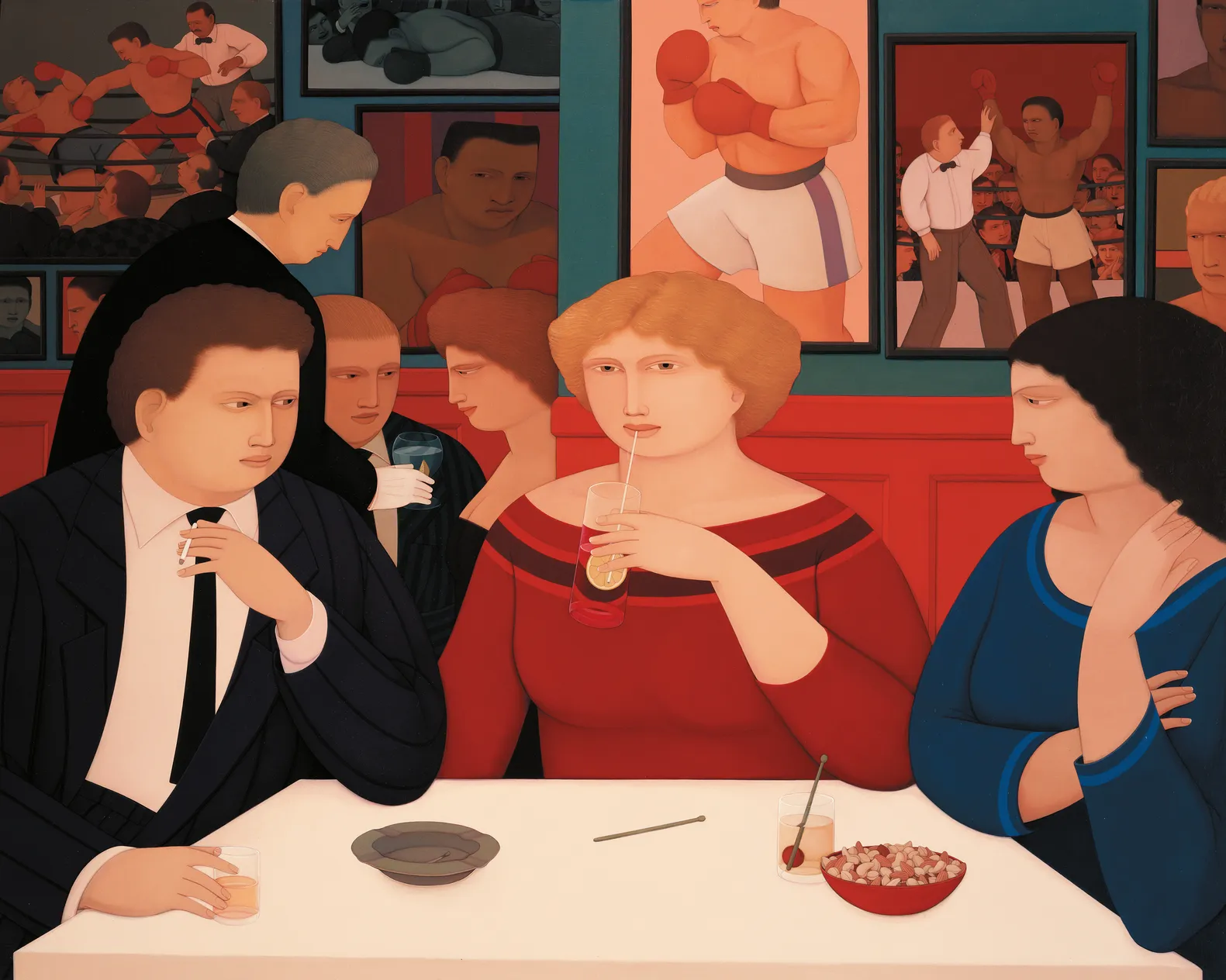
- One-Shot Jimmie’s
- 1987–1988
- Oil on linen canvas
- 40 x 50 inches
- 101.6 x 127 cm
- Private Collection
- View Artwork Page
Photography
Photography records for the catalogue are incomplete, and for many works the original photographic attribution is likely no longer recoverable. Where known, the catalogue acknowledges photographers who have documented Andrew Stevovich’s work over time, including Quesada/Burk, Greg Heins, Thomas Powell, Light Blue Studio, John Bigelow Taylor, Steward Clements, Hubbard Toombs, Alex Stevovich, Adam Adelson, and Andrew Stevovich himself.
Text Authorship and Context
The website contains several categories of written material, each presented with distinct authorship and purpose.
The About and Methodology pages are authored by Alex Stevovich and are presented as contextual essays intended to introduce the artist’s work and to document his working process. The Methodology text is based on extended discussion between Alex and Andrew that has been shaped into an essay describing materials, techniques, and approach across the body of work.
Texts authored by Andrew Stevovich himself are presented within the Writing section and are attributed accordingly.
Independent critical writing, reviews, and essays by third parties are presented separately and credited to their respective authors. These texts represent individual perspectives and do not constitute a single interpretive position for the catalogue.
Acknowledgment
The compiler wishes to acknowledge the assistance of galleries, institutions, and individuals whose prior documentation and organizational efforts contributed source material to this catalogue. These include Adelson Galleries, the Adelson family and staff, Hubbard Toombs, the Clark Gallery, and Coe Kerr Gallery, among others.
This acknowledgment reflects the use of historical records and published materials and does not imply direct collaboration on the preparation of the catalogue itself.
Editorial and Technical Approach
This catalogue has been developed with an emphasis on clarity, durability, and long-term stewardship. The site is designed to function as a stable reference rather than a time-bound presentation, avoiding visual or technical elements that may date quickly or obscure the underlying record.
All content is structured semantically to support readability, accessibility, and future maintenance. The archive is built as a cohesive data document with multiple views, allowing the same information to be navigated through artworks, career records, themes, and related materials without duplication or loss of context.

- Woman in Clover
- 1990
- Oil on linen canvas
- 4.5 x 4.5 inches
- 11.4 x 11.4 cm
- Private Collection
- View Artwork Page
Ongoing Process and Future Updates
It is important to clarify that this catalogue is not yet a complete, verified catalogue raisonné. Rather, it represents an ongoing effort to build a comprehensive and evolving record of Andrew Stevovich’s works. The catalogue is open to continuous corrections, updates, and refinements as new information and research become available. As such, it is a living document that will mature over time with the contribution of new data and insights. This approach ensures that the archive remains accurate and relevant as the project progresses.
Documentation Limits and Record Status
Information presented in this catalogue is based on available gallery records, published materials, and artist-held documentation. While every effort has been made to ensure accuracy, some details—particularly measurements and technical data—may reflect inconsistencies present in historical records.
The catalogue has been assembled without direct access to the physical artworks themselves. As a result, certain data points could not be independently re-measured or re-verified and are presented as documented rather than empirically confirmed.
Source Records and Verification
The availability of supporting documentation varies across Andrew Stevovich’s work, particularly outside the core body of oil paintings. Some works have incomplete, fragmentary, or difficult-to-recover records.
Because the catalogue is structured around relationships between artworks, exhibitions, and publications, a baseline level of information is required for full integration. Where documentation is limited, works may appear with partial records or reduced connectivity.
In cases where key details could not be verified, provisional data has been assigned to allow works to be represented within the catalogue. Any such instances are clearly noted within individual artwork records. The catalogue prioritizes inclusion of the visual work itself over omission, and records are reviewed as additional information becomes available.
Provisional data is included when documentation is incomplete or when historical inconsistencies exist. This approach allows the catalogue to represent as much of the artist’s work as possible, while maintaining academic rigor. All such entries are clearly marked as provisional and will be updated as new information becomes available.
Ongoing Work
The catalogue is a living archive. While it represents a substantial and carefully assembled record, it remains open to refinement and expansion as additional works, documentation, and historical material come to light.
Corrections, additions, and updates are made deliberately and with respect for the integrity of the existing record. The goal is not completion in a final sense, but continuity—ensuring that the work remains accurately documented and meaningfully connected for future viewers.
Future Plans: Essays
As the catalogue continues to mature, a future phase of the project may include invited essays by writers, critics, scholars, and others who have engaged thoughtfully with Andrew Stevovich’s work. These essays would not be tied to individual exhibitions or specific works, but would instead reflect on the catalogue as a whole—drawing connections, observations, and interpretations that emerge when viewing the complete body of work together.
This approach treats scholarly and critical writing as a living component of the archive, integrated directly into the catalogue rather than positioned as an external or parallel publication. Any such essays would be presented as independent perspectives, contributing to an ongoing dialogue around the work without asserting a singular or definitive interpretation.