

Andrew V. Stevovich
- Brian R. Kologe
- Art New England, vol.1, #6.
- 04/30/80
Attracted to the Renaissance masters as a boy, Andrew V. stevovich haunted the National Gallery. That background, coupled with an acknowledged fascination with the sort of persona that inhabit family albums, may account for his facility in composing human subjects. Although he initially pursued hard-edge abstraction, he turned to figures because he felt the same formal challenge present, with the added appeal of a psychological dimension.
Though not explicitly narrative, Stevovich's unique and enigmatic paintings come teasingly close. Ordinary rather than heroic creatures, inscrutably preoccupied and wearing expressions of satiety, boredom, furtive curiosity, or veiled erotic interest, assemble themselves into tableaux vivants, and seem to abandon themselves to some inaudible, pacifying music. The figures, culled from life, and then distilled or augmented by the artist's imagination, resemble characters in the literary or dramatic sense. Like people met once at a forgotten party, they remain anonymous, yet familiar. Eventually however, we recognize their surreptitious glances and tentative gestures, locked in the amber and ice of Stevovich's impressive glazes, as our own. Given the advantage of watching this quotidian soap opera through a one-way mirror, we peer eagerly into the intimacy of a suburban bedroom where an elderly judge sleeps in his robes while the young woman beside him reads; or across the perfume counter of a well-appointed department store at the customers; or over beach blankets at those public rituals that constitute seaside relation.
Stevovich's paintings, subliminal, episodic, incomplete in spite of their careful finishes, invite free association. We invent scenarios, for example, about two women, one naked the other clothed, who occupy a chesterfield with the aplomb of Giorgione shepherdesses, (with just a twinge of the scandal of Manet's Dejeuner.) Whose fingers linger uncertainly behind them? Is this John Updike's North Shore, or a new Judgement of Paris? The artist demurs, offers compositional comments. stevovich, it seems, once attempted to explain one of his works to an inquisitive admirer. His interlocutor evinced disappointment with his version, proffering an interpretation of her own.
"The lady," he recalls, "spun a Byzantine web that made me feel like a moron, and from that day on I refused to explain my paintings." The artist enlists our input, however, to supply the tonic note at the end of his open scale: "It lets people partake of the creative process. Work that does do that bores people - there's nothing left to resolve."
Rather than communicate, Stevovich seems content to observe. He catches his characters just before or just after they have spoken. In paintings like The Shell or Spectators, we participate in a complementary fashion: we observe individuals who in turn watch others, who intently ponder other subjects.
Details are chosen judiciously - floral patterns flourish and stripes weave through awnings, cravats, dresses, and wallpaper, providing tonal nuance and coherence. To test our attention the artist nonchalantly omits details, leaves out a woman's nose in Hot Dog Stand, pilfers a child's limbs or an umbrella shaft elsewhere.
Stevovich's wry, understated presentations and the periodic recurrence of certain individuals and themes attest to a Nabokovian sensibility, and an ineffable faculty that permits him to wrest from each painting a whole greater than the sum of its parts.
- Author: Brian R. Kologe
- Author Org: Art New England, vol.1, #6.
- Published: 04/30/80
- ID: andrew_v_stevovich_kologe
- UUID: 13852d46-217b-4645-b60b-c9d0326d62c8
Notes
- This article included a reproduction of the oil painting Perfume Ladies by Andrew Stevovich.
Artworks Mentioned
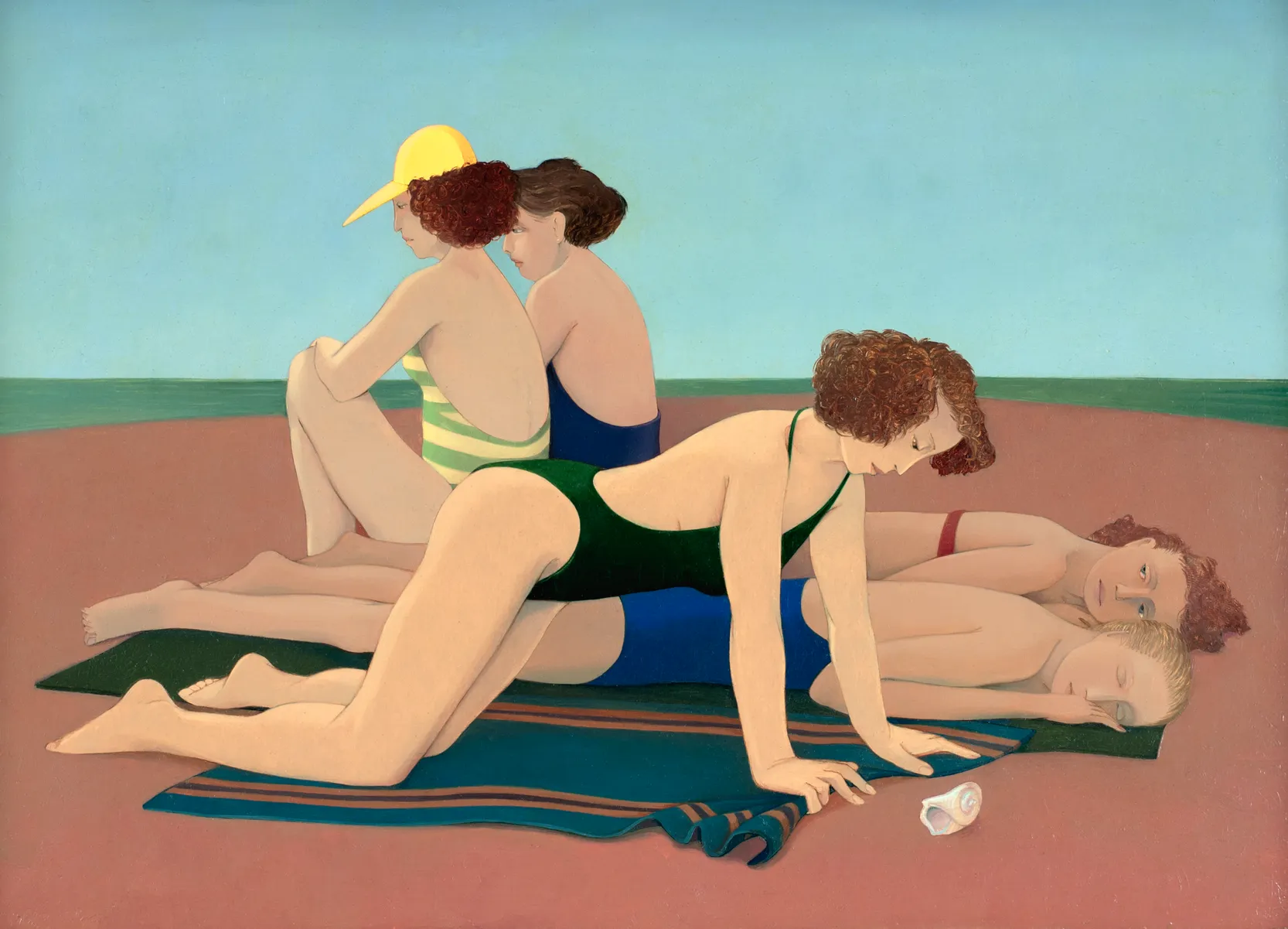
- Seashell
- 1979
- Oil on masonite panel
- 8 x 11.25 inches
- 20.3 x 28.6 cm
- Collection of the Artist
- View Artwork Page

- Spectators
- 1977–1978
- Oil on linen canvas
- 16 x 22 inches
- 40.6 x 55.9 cm
- Private Collection
- View Artwork Page
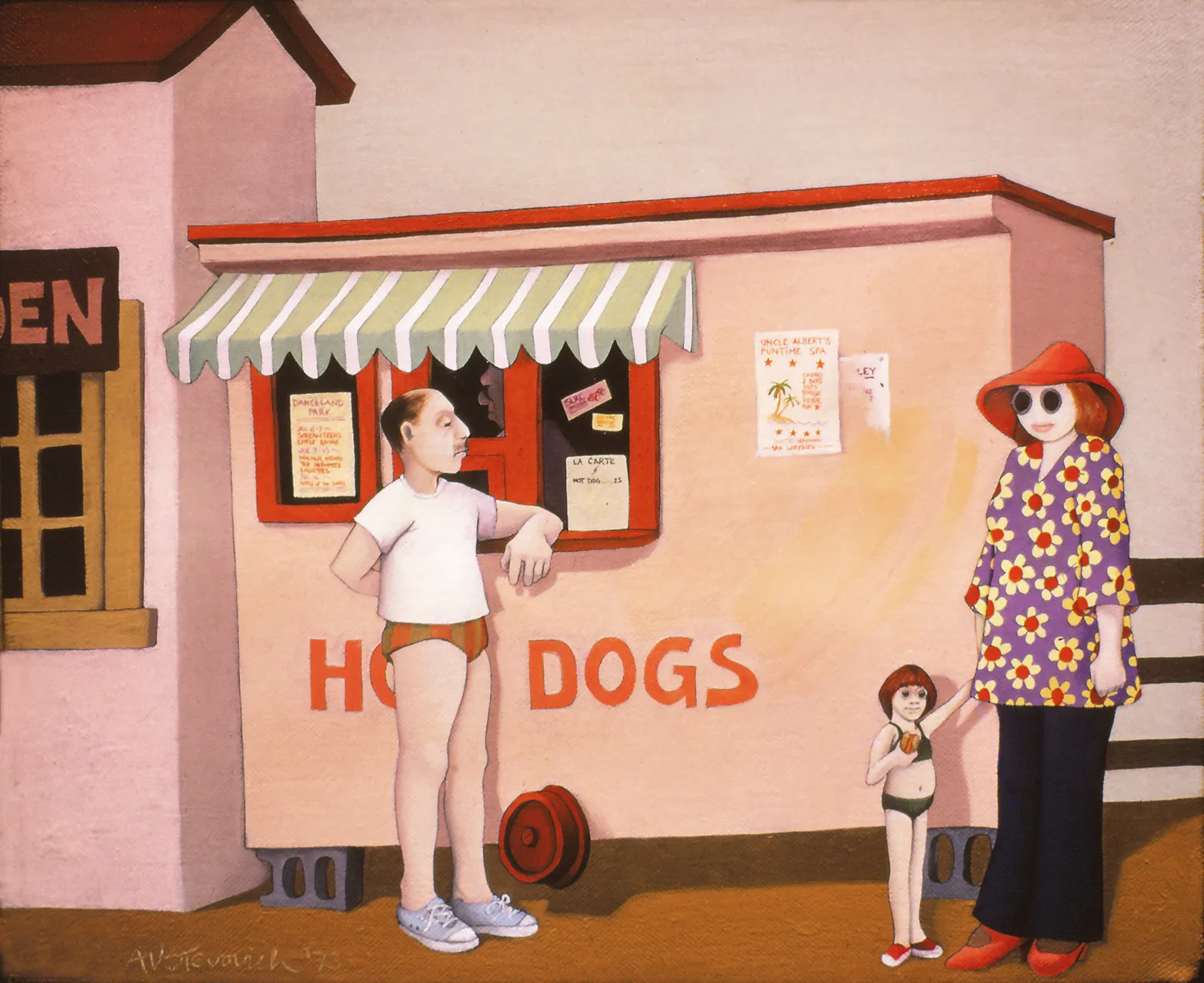
- Hot Dog Stand
- 1973
- Oil on linen canvas
- 8 x 10 inches
- 20.3 x 25.4 cm
- Private Collection
- View Artwork Page
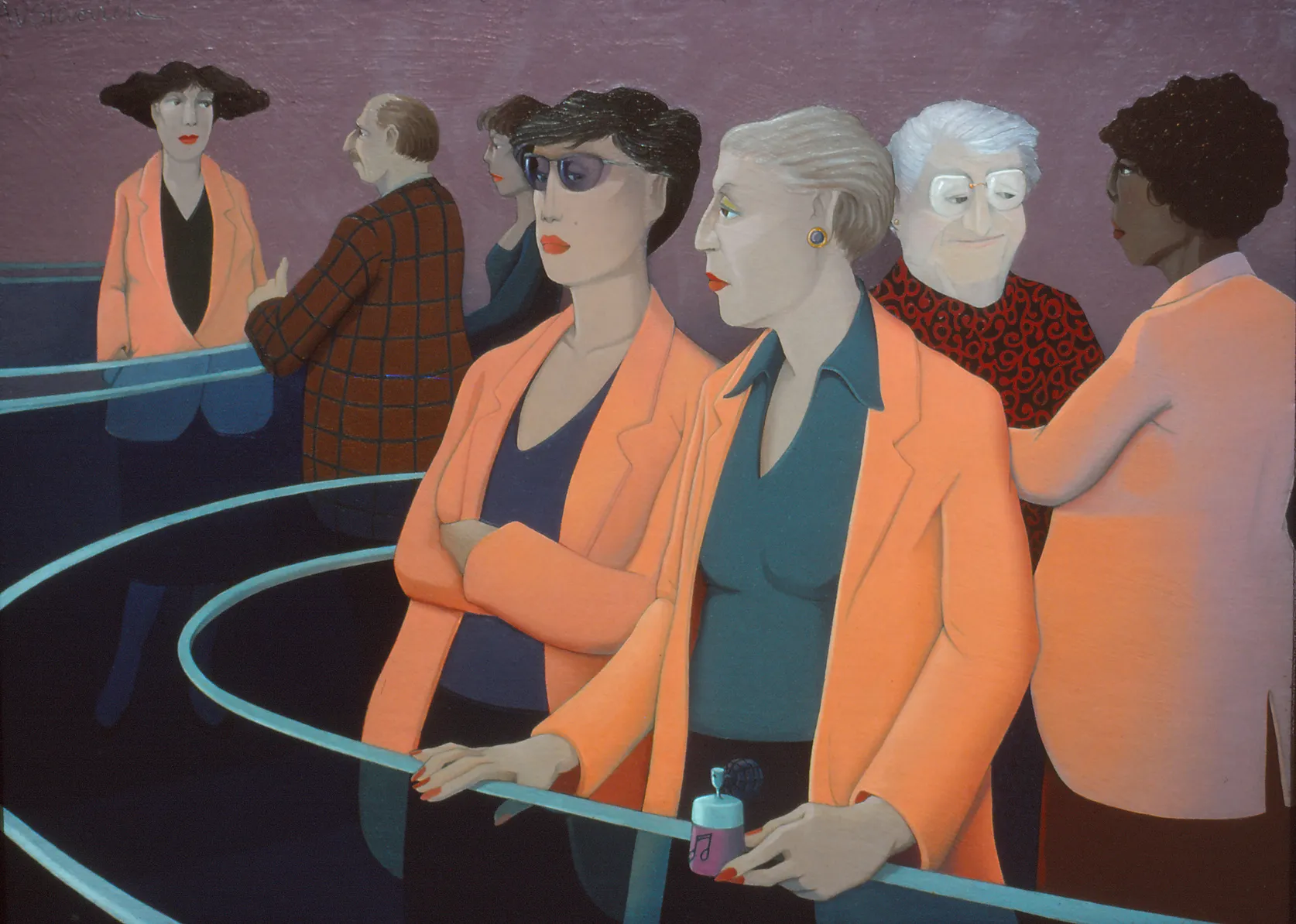
- Perfume Ladies
- 1977
- Oil on linen canvas
- 8.5 x 11.75 inches
- 21.6 x 29.8 cm
- Private Collection
- View Artwork Page